
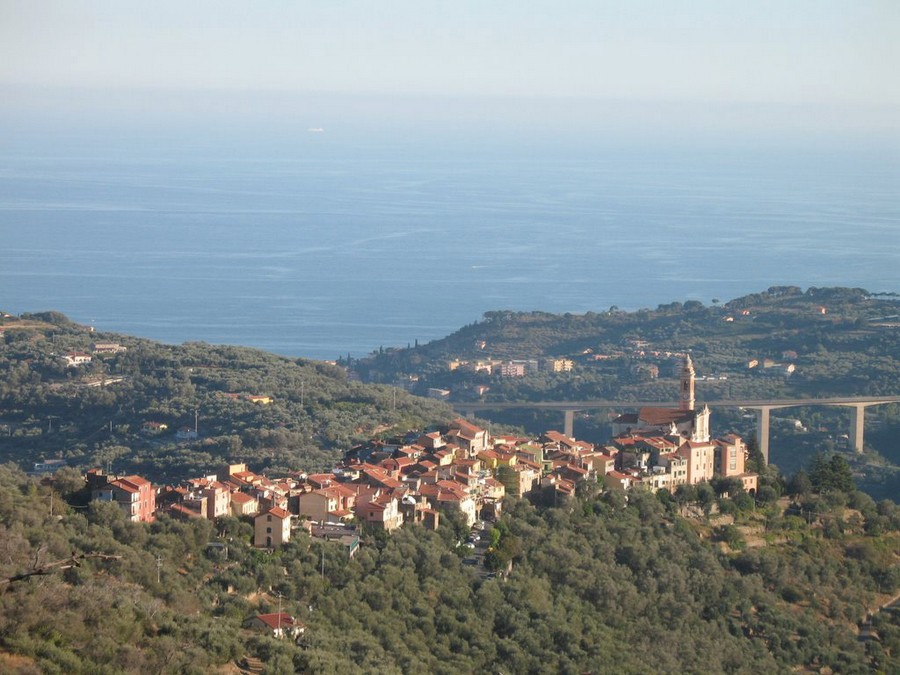
Altitude: 222 m a.s.l.
Area: 34 sq km
Distance from Imperia: 9 km
Inhabitants: in 1881: 1141 - in 2017: 609
Patron Saint Day: April 25th - San Marco Evangelista
Information: Municipality phone 0183 930190
According to the tradition, Civezza was founded around the year 1000 by three Venetian refugees (Arigo, Dolca and Ricca), which would explain the unusual cult of San Marco practiced in the village.
As far as the toponym is concerned, its most ancient attestation, contained in medieval documents of the thirteenth century and precisely in deeds of 1225 and 1241, refers to the San Lorenzo stream, called “aqua Civetie”, which divided the territory of Santo Stefano di Villaregia from that of Porto Maurizio.
No connection with Switzerland but a similarity with the toponym of Civezza (Sivizzo).
Formerly a domain of the Clavesanas after the collapse of the Arduinic border district, Civezza was bought in 1162 by the "Genoese" Porto Maurizio, to whom it remained subjected ever since.
Visit of the town
Arriving by car, circumvent the village and enter on the left through Via Dante and then proceed to park further on to the right below Piazza Carducci.
The town developed along the central Via Dante which offered at both ends the only access gates to the fortified village protected respectively by the bell tower and a tower; it has no great monuments to offer but its modest urban fabric has largely been well preserved and therefore today it offers a visit to a simple genuine Ligurian village of several centuries ago.
A sundial has been preserved on the wall of the house overlooking the parking lot.
Walk to the right on Via Dante and, after passing the marble shield on the upper part of the door at number 2, reach the small square with a central fountain.
Among the different roads you are now facing, take the one on the left (Via Tasso), flanked by archaic poor houses with "ciappe" roofs, divided by narrow alleys just a bit over half a meter wide; to enter in a full medieval environment go down to the left on Via Lavatoio and, after passing under the archivolt, you’ll find yourself on Via Tasso; this is the poorest part of the village, with only a few hints of distinction such as the marble shield carved in a Trigram at number 29.
Continue taking the right on Via Ariosto; at the corner there is one of the towers of the town, later incorporated and hidden by the houses.
From there pass under the arch on the left, then left again on Via Dante which, past the turret on the right on Via Ortis, leads you to Piazza San Marco with its classic black and white cobblestones on which stands the parish church of San Marco, originally of the fifteenth century yet completely rebuilt in 1783 to a design by Tommaso Carrega.
Inside is a wooden statue of the Virgin of 1645 in the third altar on the right, and a similar marble statue of 1681 is in the last altar on the left.
The bell tower dominates the entire valley below thus acting also as an efficient sighting tower and preserves, in the original lower part, the loopholes that made it an effective bastion to defend the southern access to the village.
Next to the church stands the Baroque oratory of San Giovanni, faced by the building with a beautiful Baroque portal and a spiral column, the current seat of the "Congregation of the Servants of Jesus Christ".
Next to the entrance you can go down under the big vault that holds the whole churchyard; the most curious ones, venturing under this vault and then under the other one that opens to the left, will find embedded on the left wall column trunks that seem to be all what remains of the original church after the rebuilding of Carrega.
Going back along Via Dante you’ll find other small signs of distinction, such as the Trigram-carved shield on the arch that crosses the street, the aedicule with the statue of the Virgin on the right at the corner with Via Ariosto, and the black stone portal with shelves at number 49; once in Piazza Marconi go down a few steps to the left and, past the black stone portal with a marble Trigram at number 8, you’ll arrive to the double arch beyond which opens the view over the valley covered with olive trees.
Back to the small square, take the left on Via Dante passing the marble overdoor with a Trigram and an aedicule at number 16, the black stone architrave carved with a Trigram, a cross and the initials F.B. at number 23 and the analogous one with the initials B.R. at number 25.
Above number 29, partially concealed by the vault, there is a tower that has kept the machicolation shelves above; you can see it better by continuing along Via Dante and then turning to look back.
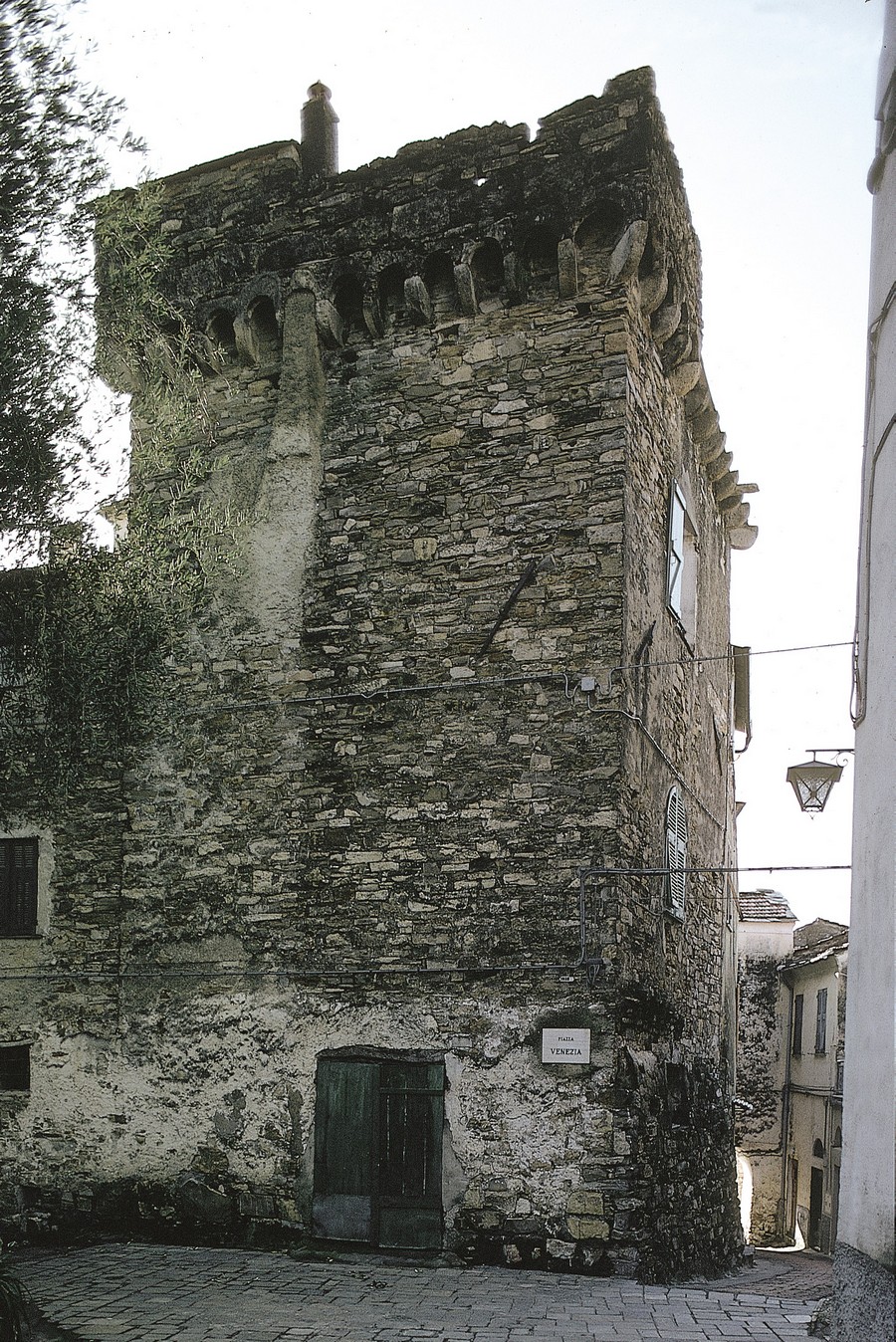
After crossing the intersection, at the end of the street on Piazza Venezia you’ll find Torre degli Svizzeri, erected there to defend the eastern gate of the town. The bulwark, perfectly preserved, has a square plan and an intact machicolation crowning along the entire perimeter; the side facing the street preserves the vault of the now disappeared gate that led to the village, and the window through which the guardhouse controlled who entered and left the town.
Back to the car, go back down the valley taking the left to arrive to the Baroque church of San Rocco, next to the shelter; from there, if you go back down the ramp and turn left, in less than a kilometer you’ll reach the Baroque chapel of Madonna delle Grazie at the center of the junction that leads to Dolcedo on the left and to Imperia on the right.
Going back instead on the road already traveled, at the junction to the cemetery you’ll find on the right the church of San Salvatore with a stone porch with seats; the interior is completely bare.
From there in a few kilometers you can return to Via Aurelia.